

Malaysia is a country known for its remarkable cultural diversity. Located in Southeast Asia, the nation brings together communities with different ethnic backgrounds, languages, religions, traditions, and historical influences. This diversity has shaped Malaysia into a society where ancient customs and modern lifestyles exist side by side.

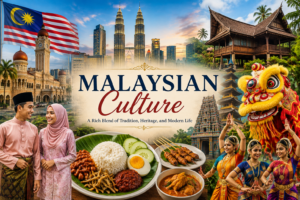
Malaysian culture
From traditional celebrations and colorful clothing to distinctive cuisine, music, architecture, and family traditions, Malaysian culture offers a fascinating reflection of the country’s long history. Understanding Malaysian culture therefore means looking beyond a single tradition and appreciating the many communities that contribute to the country’s identity.
A Multicultural Society
One of the most distinctive characteristics of Malaysian culture is its multicultural population. The country’s major communities include Malays, Chinese, Indians, as well as various Indigenous groups.
Each community has developed its own traditions while also interacting with other cultures over generations. This interaction can be seen in everyday life, particularly in food, language, festivals, clothing, and social customs.
Malay culture has a particularly important place in the country’s national identity. At the same time, Chinese and Indian Malaysian communities have preserved many customs brought by their ancestors. Indigenous communities across Peninsular Malaysia, Sabah, and Sarawak also contribute unique traditions and cultural practices.
This combination creates a cultural landscape that is both diverse and interconnected.
Malaysian Languages
Language is another important part of Malaysian culture. Malay, known locally as Bahasa Melayu, is the country’s official language and plays an important role in education, government, and everyday communication.
English is also widely used, particularly in business, tourism, education, and professional environments. In addition, many Malaysian communities speak Chinese languages and Indian languages such as Mandarin, Cantonese, Hokkien, Tamil, and others.
Indigenous communities have their own languages as well. This multilingual environment reflects Malaysia’s complex cultural history and makes communication an interesting part of everyday social life.
Traditional Malaysian Food
Food is perhaps one of the easiest ways to experience Malaysian culture.
Malaysian cuisine reflects influences from Malay, Chinese, Indian, Indigenous, and other regional culinary traditions. The result is a diverse food culture characterized by aromatic spices, herbs, coconut milk, noodles, rice, seafood, and bold flavors.
Popular dishes include nasi lemak, often regarded as one of Malaysia’s best-known national dishes. It is traditionally prepared with fragrant coconut rice and commonly served with sambal, peanuts, anchovies, cucumber, and other accompaniments.
Other well-known foods include satay, laksa, roti canai, char kway teow, nasi kandar, and various regional specialties.
Street food is also an important part of Malaysian culinary culture. Night markets and food stalls provide opportunities for people to enjoy affordable meals while socializing with family and friends.
Festivals and Celebrations
Malaysia’s multicultural society is reflected strongly in its festivals.
Hari Raya Aidilfitri is an important celebration for Muslims and marks the end of Ramadan. Families often gather, visit relatives, wear traditional clothing, and enjoy special dishes together.
The Chinese Malaysian community celebrates Chinese New Year, featuring family gatherings, traditional foods, decorations, and cultural performances.
The Indian Malaysian community celebrates festivals such as Deepavali, also known as the Festival of Lights. Homes may be decorated with colorful patterns called kolam, while families gather for prayers and festive meals.
Malaysia also recognizes Gawai Dayak in Sarawak and Kaamatan in Sabah,Aksarawin which are important celebrations among Indigenous communities.
These celebrations demonstrate how different traditions can coexist within one country.
Traditional Clothing
Traditional clothing is another visible expression of Malaysian cultural identity.
For Malay communities, garments such as the baju Melayu and baju kurung are commonly associated with traditional and formal occasions. These garments are often worn during festivals, weddings, and other important events.
Chinese and Indian Malaysian communities also maintain distinctive traditional clothing. Examples include the cheongsam and various Indian garments such as the saree.
Traditional clothing is not limited to historical ceremonies. Many Malaysians continue to incorporate traditional styles into modern fashion, creating a balance between heritage and contemporary design.
Malaysian Arts and Performances
Malaysia has a wide range of traditional performing arts.
Malay cultural performances include traditional dances such as zapin and joget. Traditional musical instruments such as the gamelan and kompang are also associated with Malaysian cultural performances.
Wayang kulit, a traditional form of shadow puppetry, has historical connections with Malay cultural traditions, particularly in parts of the east coast of Peninsular Malaysia.
In Sabah and Sarawak, Indigenous communities maintain distinctive dances, musical traditions, crafts, and ceremonies. These traditions reflect the close relationship between cultural identity, community, and the natural environment.
Batik and Traditional Crafts
Malaysian batik is another important cultural expression. Batik uses wax-resist techniques to create patterns on fabric, often featuring flowers, leaves, geometric shapes, and other natural motifs.
Traditional crafts also include weaving, wood carving, beadwork, pottery, and basket making. In Sabah and Sarawak, traditional handicrafts can reflect the identities of individual Indigenous communities.
These crafts are not simply decorative. They can carry historical, symbolic, and cultural meanings that have been passed down through generations.
Architecture and Cultural Heritage
Malaysia’s architecture also demonstrates the country’s cultural diversity.
Traditional Malay houses are designed with consideration for the tropical climate. Raised structures, open spaces, and ventilation help create comfortable living environments in hot and humid conditions.
Malaysia’s cities also contain buildings influenced by Chinese, Indian, Islamic, colonial, and modern architectural traditions. Historic areas such as George Town and Melaka demonstrate how different cultural and trading influences have shaped Malaysian urban environments.
Mosques, temples, churches, and other religious buildings can often be found within the same broader communities, reflecting the country’s religious and cultural diversity.
Family and Community Values
Family plays an important role in Malaysian society. Respect for parents, elders, and extended family members remains significant across many communities.
Social relationships are often built around gatherings, shared meals, celebrations, and community activities. Hospitality is also highly valued, with guests frequently being welcomed with food and refreshments.
The concept of gotong-royong, referring broadly to community cooperation and mutual assistance, is another example of a social value associated with Malaysian life. It emphasizes the importance of working together for the benefit of a community.
Religion in Malaysian Culture
Religion is an important part of Malaysia’s cultural landscape. Islam is the country’s official religion, while the constitution also provides for freedom of religion.
Muslims, Buddhists, Christians, Hindus, and followers of other faiths contribute to the country’s religious diversity.
Religious traditions influence festivals, architecture, food practices, clothing, and daily life. This diversity is particularly visible in major cities, where mosques, temples, churches, and other places of worship can be found within multicultural communities.
Modern Malaysia and Cultural Change
Although Malaysia has deep cultural roots, its society continues to change.
Urbanization, technology, international travel, social media, and global entertainment have influenced how younger generations interact with traditional culture. Malaysian music, fashion, food, and creative industries increasingly combine local heritage with contemporary influences.
This does not necessarily mean traditional culture is disappearing. Instead, many traditions are being adapted to new environments.
For example, traditional motifs may appear in modern fashion, Malaysian cuisine may be presented through contemporary restaurants, and traditional music can be combined with modern musical styles.
Conclusion
Malaysian culture is best understood as a living combination of traditions, communities, history, and modern influences. Malay, Chinese, Indian, and Indigenous cultures all contribute distinctive elements to the country’s identity, while centuries of interaction have created cultural practices that are uniquely Malaysian.
Food, festivals, clothing, language, music, crafts, architecture, family traditions, and religious diversity all tell different parts of Malaysia’s cultural story.
What makes Malaysia particularly interesting is not simply the existence of many cultures, but the way these traditions interact in everyday life. Its cultural identity continues to evolve while maintaining strong connections to its historical roots.
For visitors and readers interested in Southeast Asia, exploring Malaysian culture provides an opportunity to discover a country where tradition and modernity meet, cultures intersect, and heritage continues to find new forms of expression.