



Understanding Indian Culture and Everyday Life: A Journey into the Soul of India
culture of india Image 3 Jan 2026, 11.02.34
India is not merely a country; it is a living civilization that breathes through its traditions, routines, contrasts, and collective memory. To understand Indian culture and the daily life of its people is to step into a landscape where the ancient and the modern coexist without canceling each other. From crowded cities to quiet villages, from ritual-filled mornings to reflective evenings, everyday life in India is a mosaic shaped by history, belief, resilience, and rhythm.
The Cultural Foundation of Indian Society
Indian culture is deeply rooted in continuity rather than uniformity. Unlike societies that seek homogeneity, India thrives on plurality. Languages, religions, cuisines, clothing styles, and customs change every few hundred kilometers, yet a shared cultural consciousness binds them together.
At the core of Indian culture lies the concept of Dharma, a word that loosely translates to duty, moral order, and the right way of living. Dharma guides personal behavior, family responsibility, social interaction, and even professional ethics. It is not enforced by law but lived through values passed down across generations.
Respect for elders, hospitality toward guests, and community-centered living are not ceremonial gestures but everyday practices. In many households, the phrase “Atithi Devo Bhava” (the guest is equivalent to God) still shapes how people treat visitors, even strangers.
Family Life and Social Bonds
Family is the central axis of Indian daily life. While nuclear families are becoming more common in urban areas, the idea of the joint family remains culturally significant. Multiple generations often live under one roof or maintain close interdependence.
Daily routines frequently revolve around family needs. Meals are often shared, decisions are discussed collectively, and major life choices such as education, marriage, or relocation are rarely made in isolation. This collectivist mindset contrasts with individualistic cultures but provides a strong emotional safety net.
Marriage in India is not merely a personal union but a social institution. Even today, arranged marriages coexist with love marriages, and both are framed as alliances between families rather than just individuals.
Morning Rituals and Daily Rhythms
A typical day in India often begins early. Morning hours are considered sacred and productive. Many people start their day with personal rituals such as prayer, meditation, or yoga. These practices are not always religious in a strict sense; they are habits meant to align the body and mind before engaging with the world.
Tea, especially chai, plays a symbolic and practical role in daily life. Shared at home, roadside stalls, offices, and train platforms, chai is more than a beverage. It is a pause, a conversation starter, and a social equalizer.
In urban areas, mornings quickly transition into the rush of work, traffic, and school schedules. In rural regions, the day may begin with agricultural tasks, tending animals, or preparing for local markets.
Food as a Cultural Language
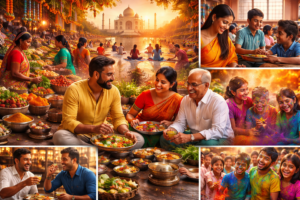
Indian cuisine is one of the most expressive aspects of everyday life. Food is not just nourishment; it is identity, memory, and ritual. Meals vary widely depending on region, religion, climate, and season.
A typical daily meal might include rice or flatbread, lentils, vegetables, and spices blended with precision rather than excess. Contrary to stereotypes, not all Indian food is spicy. Balance, texture, and digestion play crucial roles in meal preparation.
Eating habits are often mindful. In many homes, meals are eaten without distraction, sometimes seated on the floor, reinforcing humility and gratitude. Fasting on specific days is also common, not as deprivation but as discipline and spiritual reset.
Work, Profession, and Modern Aspirations
India’s work culture is a blend of persistence and adaptation. Traditional occupations such as farming, weaving, pottery, and trade continue alongside rapidly growing sectors like technology, finance, media, and startups.
For many Indians, education is viewed as the primary vehicle of social mobility. Students often face intense academic competition, but this pressure is accompanied by strong family support and collective ambition.
Urban professionals navigate long commutes, demanding schedules, and global work environments, while still maintaining cultural practices at home. It is not unusual for someone to attend a corporate meeting by day and a religious ceremony by evening without perceiving any contradiction.
Religion in Everyday Life
Religion in India is not confined to temples, mosques, churches, or shrines. It permeates daily actions, language, and timekeeping. Bells ringing at dawn, incense in the air, symbols on doorways, and festivals throughout the year mark the spiritual cadence of daily life.
Importantly, religious identity often coexists with tolerance. In many neighborhoods, people of different faiths live side by side, sharing festivals and respecting rituals even when they do not practice them personally.
Spirituality is often inward rather than performative. For many Indians, faith is less about dogma and more about continuity, comfort, and moral anchoring.
Clothing and Personal Expression
Traditional clothing remains part of daily life, especially in smaller towns and during festivals. Sarees, kurtas, dhotis, and salwar suits are worn not as costumes but as functional attire adapted to climate and culture.
At the same time, modern fashion blends seamlessly into daily wardrobes. Jeans and traditional tunics coexist, reflecting India’s ability to integrate change without erasing heritage.
Clothing choices often reflect social context rather than rigid rules. Modesty is valued, but expression is not suppressed. Color, fabric, and symbolism play important roles in how people present themselves.
Communication and Social Interaction
Indian communication tends to be indirect, layered, and context-sensitive. Politeness, tone, and non-verbal cues often carry more weight than direct statements. Silence can be meaningful, and pauses are not always uncomfortable.
Hospitality is expressed through repeated offers of food, tea, or assistance. Refusing too quickly may be considered impolite, while acceptance strengthens social bonds.
Public spaces are lively and communal. Markets, streets, and festivals are social theaters where daily life unfolds in full visibility.
Festivals and Shared Joy
Festivals punctuate the Indian calendar with color, music, and collective emotion. They are not isolated events but extensions of everyday life intensified. Whether religious, seasonal, or regional, festivals bring families together, renew social ties, and temporarily suspend routine.
Preparation often begins days or weeks in advance. Cleaning homes, cooking special foods, decorating spaces, and buying new clothes are part of the ritual.
These celebrations reinforce a sense of belonging and continuity, reminding people that life is not only about survival but also about shared joy.
The Balance Between Tradition and Change
One of the most striking aspects of Indian daily life is its comfort with contradiction. Technology advances rapidly, yet traditions endure. Smartphones coexist with handwritten rituals. Global influences enter local spaces but rarely replace them entirely.
Change in India is additive rather than destructive. New practices are absorbed, localized, and reinterpreted rather than blindly adopted.
This adaptive resilience allows Indian culture to remain dynamic without losing its core.
Conclusion: The Everyday Poetry of India
To understand Indian culture and the daily life of its people is to recognize that meaning often lies in repetition. Small rituals, shared meals, morning greetings, evening prayers, and quiet resilience form the invisible architecture of Indian society.
India’s everyday life may appear chaotic to an outsider, but within that complexity lies an intricate order shaped by memory, respect, and coexistence. It is a culture that does not rush to discard the past nor fear the future.
In the ordinary moments of Indian life, one finds an extraordinary continuity that has survived centuries of change. And it is in these daily rhythms that the true spirit of India quietly endures.